Contact Online Customer Service


Scan the QR code on WeChat to follow the official account

Scan for free preliminary review and quote
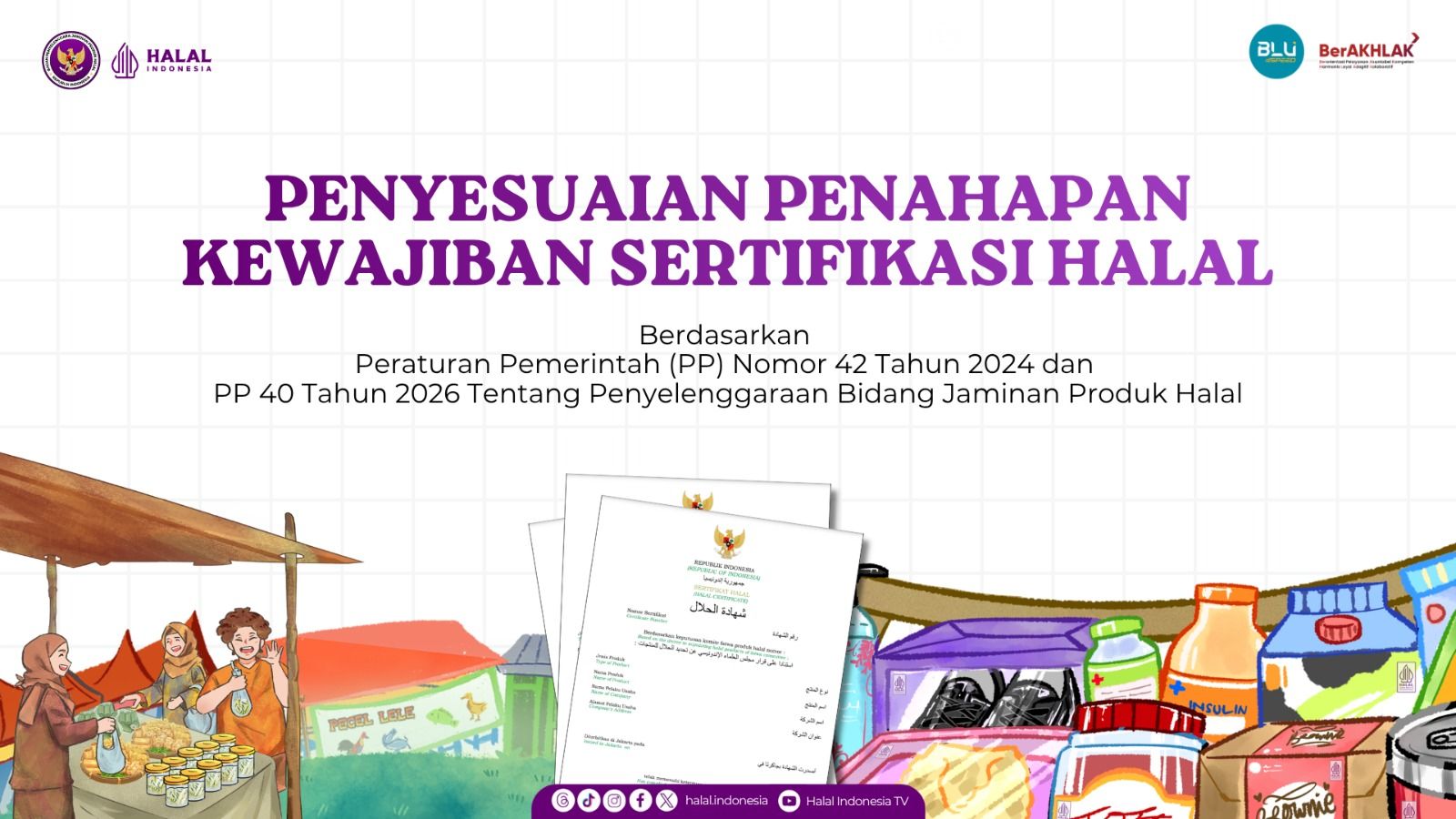
Jakarta --- The Halal Product Assurance Organizing Agency (BPJPH) emphasizes that the adjustment to the phased halal certification obligation timeline via Government Regulation No. 40 of 2026, which amends Government Regulation No. 42 of 2024 on the Implementation of Halal Product Assurance, is part of the government's efforts to strengthen the national Halal Product Assurance (JPH) implementation.
This adjustment was formulated by taking into account the readiness of the halal ecosystem, inputs from business actors and industries, as well as the need to reinforce various aspects of JPH administration. The policy also provides adjustment space for business entities to fulfill their halal certification obligations in a more planned manner, without diminishing the government's commitment to public protection and legal certainty for halal products.
The phased timeline adjustment stipulated in the 2026 Government Regulation No. 40 does not alter the fundamental principle of mandatory halal certification, which is mandated by Law No. 33 of 2014 on Halal Product Assurance, as amended by Law No. 6 of 2023. Although this phased adjustment is implemented with consideration for the readiness of the ecosystem and business actors, the principle of mandatory halal certification remains fully in force in accordance with statutory provisions. This adjustment should be interpreted and utilized as an opportunity for all business entities to prepare themselves and improve compliance, rather than as a reason to postpone halal certification implementation.
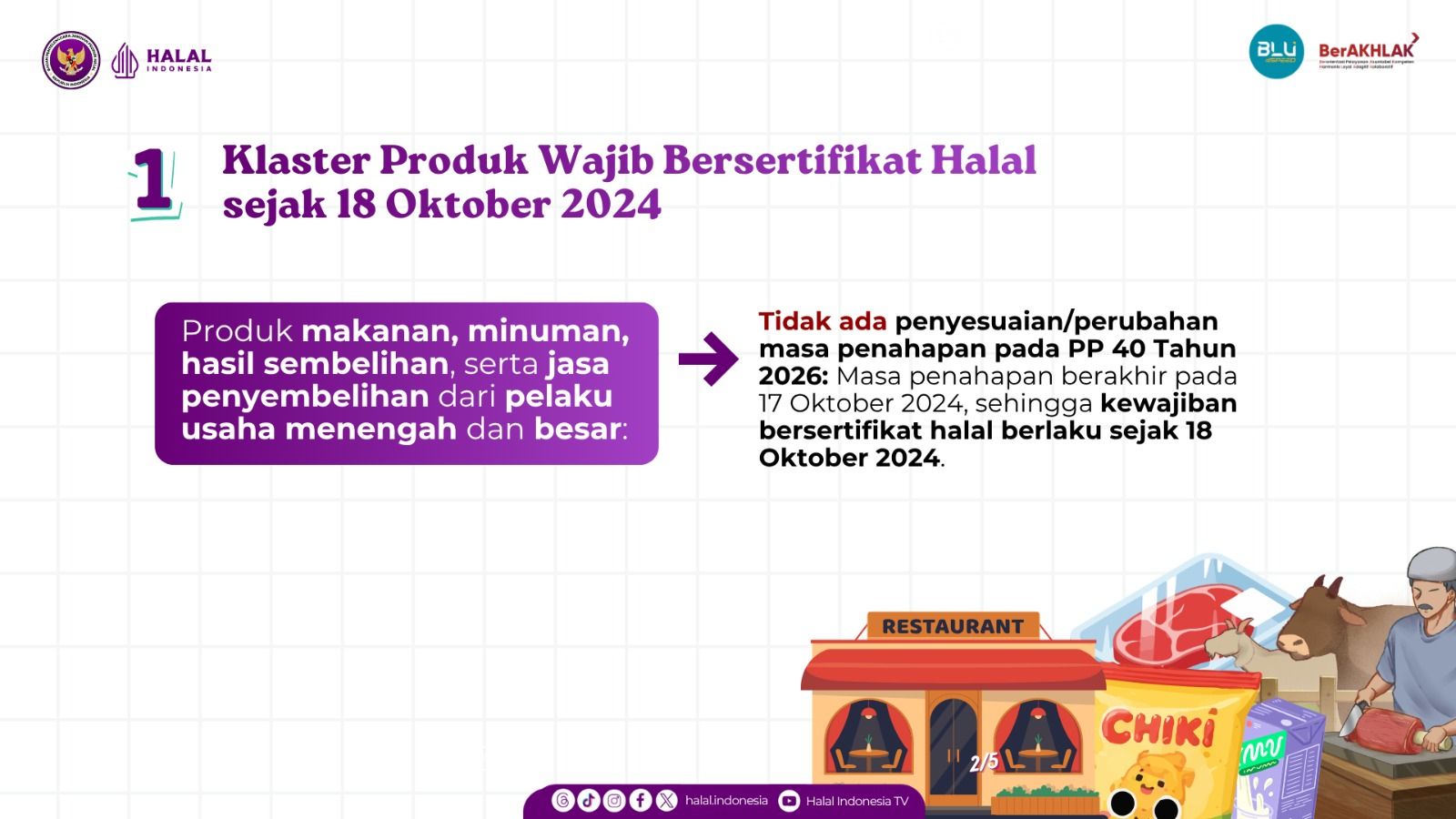
Pursuant to Government Regulation No. 42 of 2024, as amended by Government Regulation No. 40 of 2026, several product groups have had their phased mandatory halal certification timelines adjusted. Meanwhile, other product categories still follow the original phased schedule previously stipulated in Government Regulation No. 42 of 2024 on the Implementation of Halal Product Assurance.
First, the product category whose mandatory halal certification obligation has been in effect since 18 October 2024.
This group covers food products, beverages, slaughter products, and slaughter services provided by medium and large-scale business entities. For these products, Government Regulation No. 40 of 2026 does not modify the phased timeline provisions. Accordingly, the mandatory halal certification obligation remains fully enforceable as of 18 October 2024.
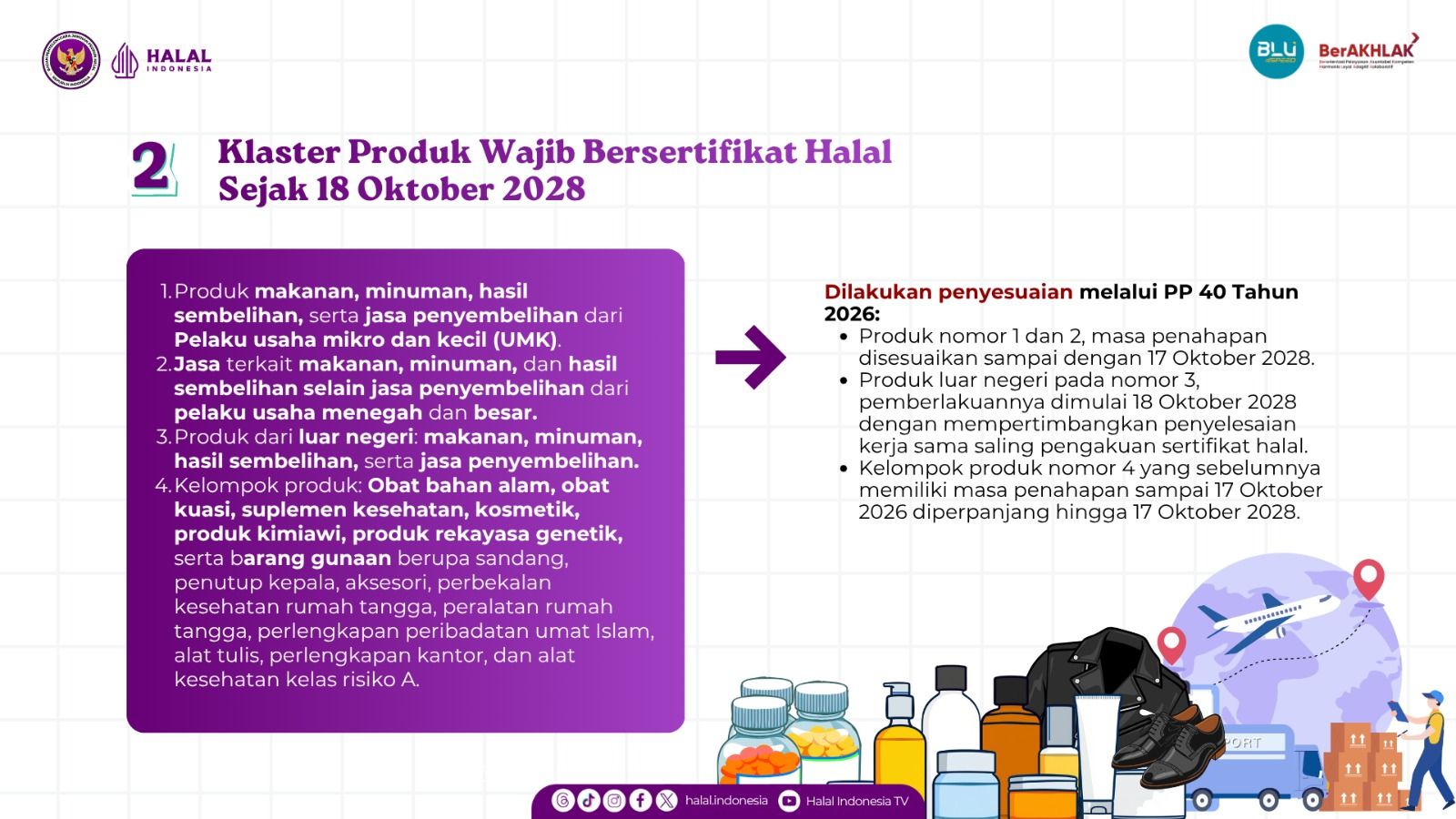
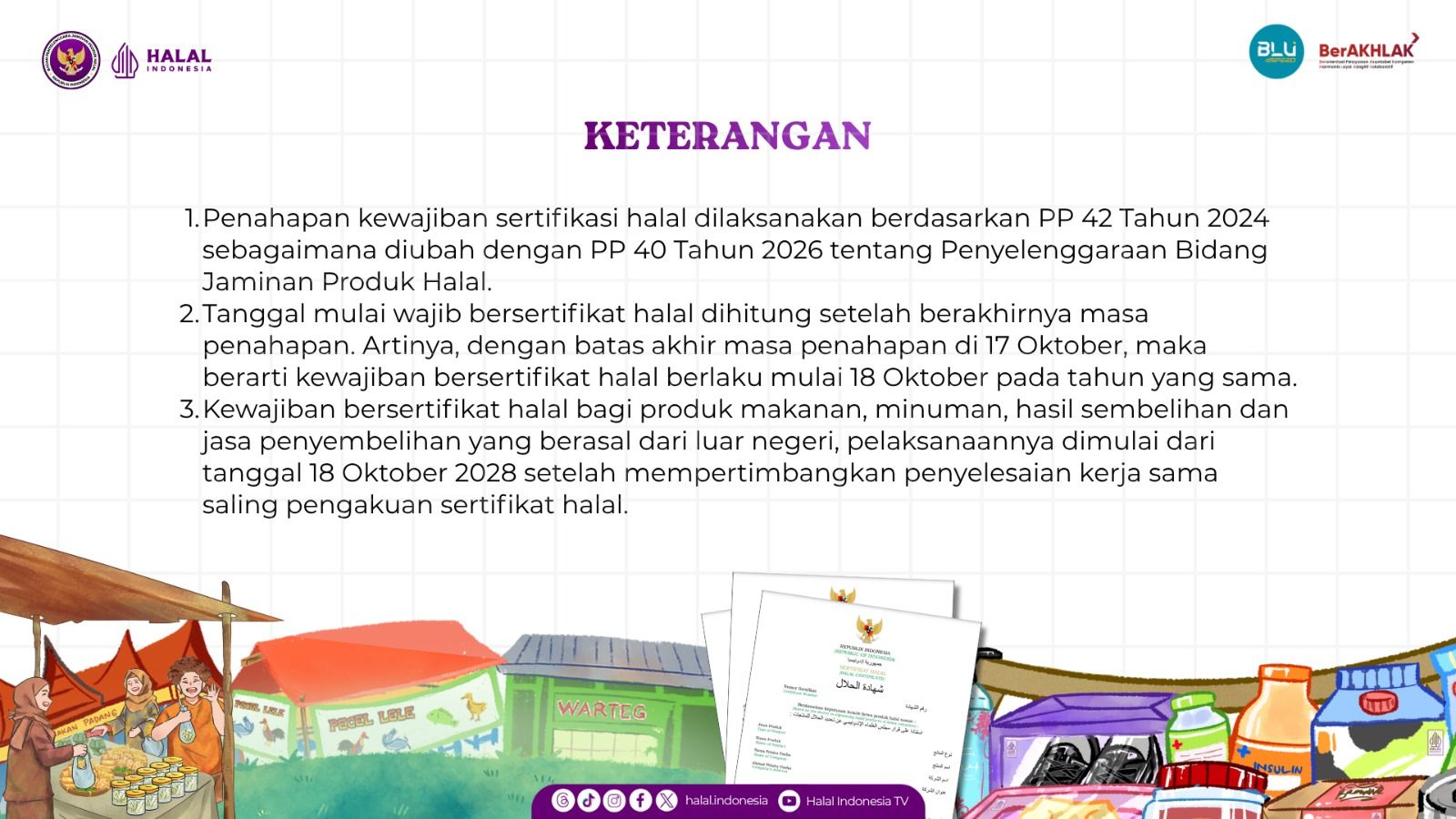
Second, the product group whose phased mandatory halal certification timeline has been adjusted to 17 October 2028.
This adjustment covers the following product categories:
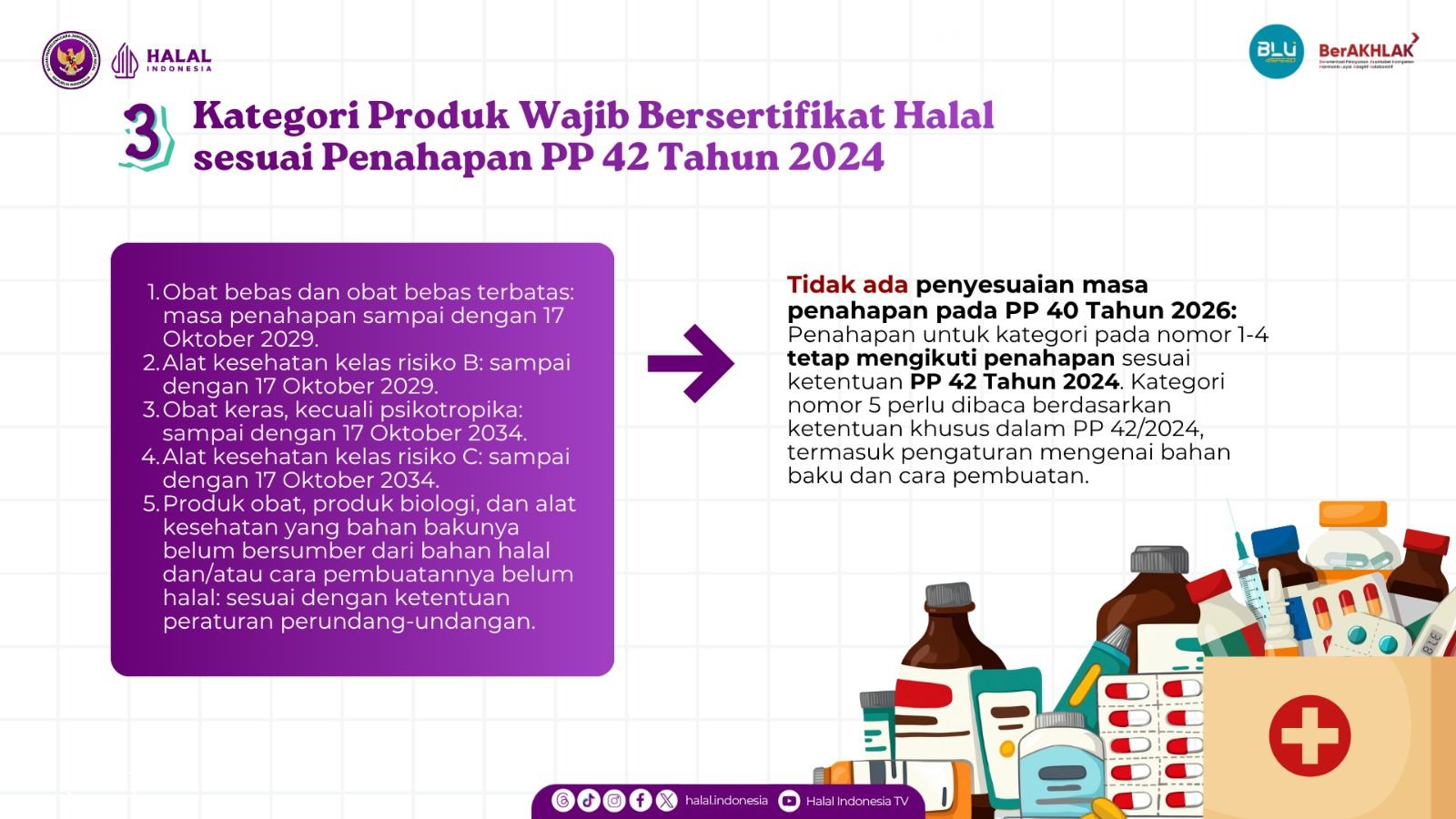
Third, the product group that still adheres to the phased timeline stipulated in Government Regulation No. 42 of 2024.
For these specific product categories, Government Regulation No. 40 of 2026 does not modify their mandatory halal certification schedules. The group includes:
This also applies to pharmaceutical products, biological products and medical devices whose raw materials do not yet come from halal sources, and/or whose production methods do not yet meet the halal requirements specified in prevailing laws and regulations.
As stipulated in the Halal Product Assurance Law (UU JPH), the implementation of the Halal Product Assurance system has two interlinked strategic objectives: to provide the public with protection and legal certainty on the halal status of products, and to boost the added value and competitiveness of domestic national products.
Through halal certification, the public gains clear certainty over the halal status of the products they consume and use. On the other hand, business entities get the opportunity to reinforce consumer trust, improve product quality, expand market access, and build competitive advantages amid the booming global halal industry.
Therefore, this phased timeline adjustment should be understood as a move to strengthen policy implementation, rather than a reduction in the government's commitment to mandatory halal certification. Business entities are expected to make full use of this adjusted period to optimally prepare for fulfilling their halal certification obligations.
The Halal Product Assurance Organizing Agency (BPJPH) also continues to strengthen synergy and collaboration with all relevant stakeholders, to build a more effective, inclusive and sustainable Halal Product Assurance system. This move will simultaneously enhance public protection and increase the contribution of the halal industry to the national economy.
The strengthened collaboration is expected to help business entities better understand the urgency of halal certification, and push them to complete the certification process as soon as possible. Specifically for micro and small enterprises (UMK), BPJPH is also continuously expanding partnerships to provide targeted guidance and facilitation services for their halal certification applications.

Good Fortune Halal Certification (Qingdao)Service Co., Ltd. , it is a professional Halal certification service provider (LHLN) officially recognized under the mutual recognition agreement with Indonesia's BPJPH, a professional certification service provider based in Qingdao and serving the entire country. We are dedicated to providing international Halal quality standard certification and related business consulting services for products exported to Indonesia or other countries. We assist in certifying and issuing international Halal certificates (HALAL CERTIFICATE) for Halal product exports to Southeast Asia, the Middle East, and other relevant regions. Upholding the service philosophy of 'fairness, scientific rigor, integrity, and efficiency,' the company aims to facilitate international trade and economic development, achieving mutual success and win-win cooperation for enterprises.
Friend Links: 福运来哈啦认证顺企网
© 2025-2026 Good Fortune Halal Certification (Qingdao)Service Co., Ltd.. Certification All rights reserved.
鲁ICP备2025168169号
 鲁公网安备37021002001640号


